
Loose 3D or 4D number plate letters: inspect or replace?
Check a lifting gel or acrylic character safely, understand why quick glue repairs are unreliable and know when to order a complete replacement plate.
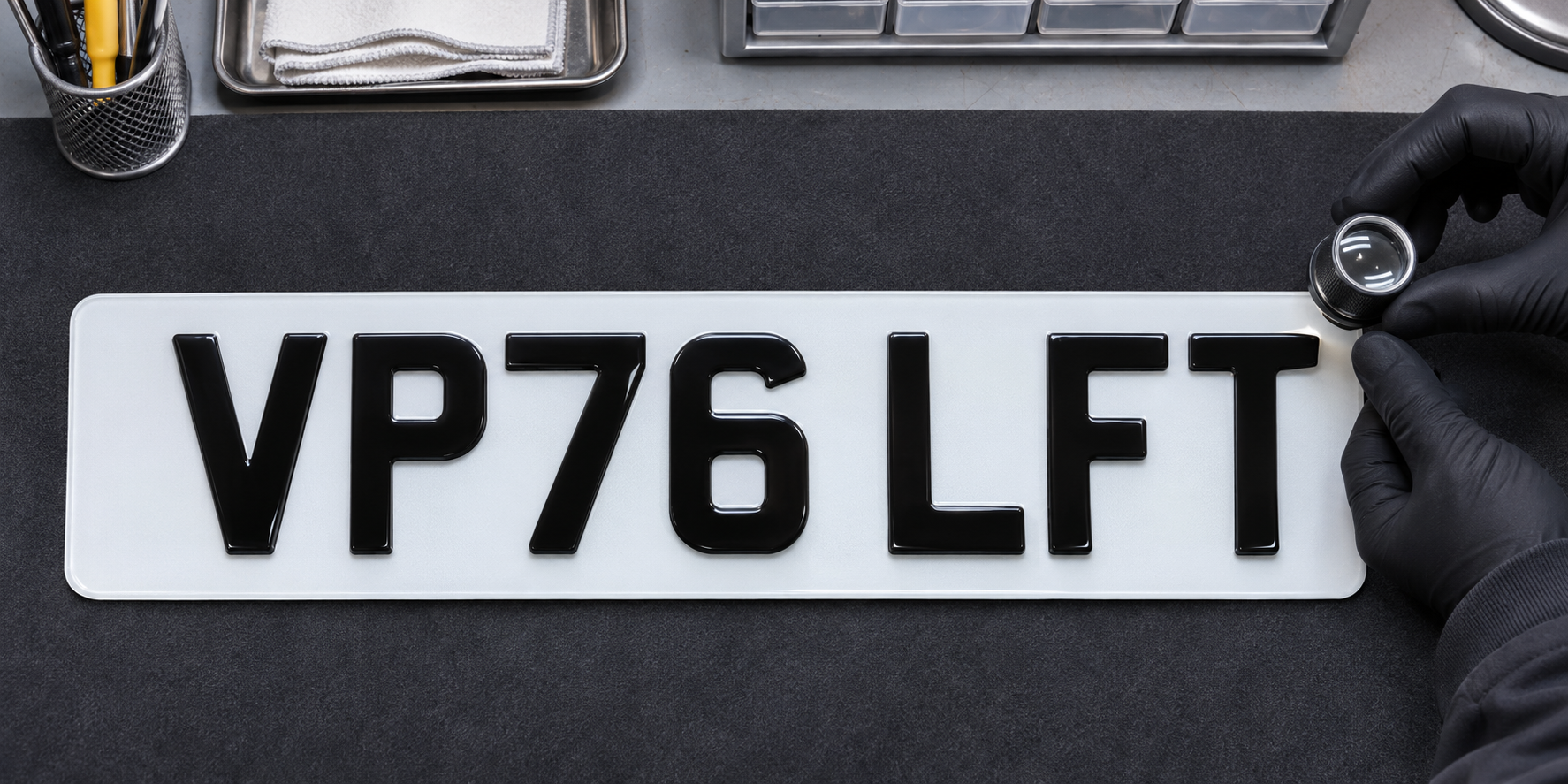
Inspect the character without pulling it
Park safely and inspect the plate while it is clean, dry and cool. Use bright, even light, then view it from a shallow angle so a gap or unusual shadow beneath a raised character is easier to see. Compare the suspect edge with the other letters and numbers.
Do not prise the character with a blade, fingernail or tool. Look for a dirt line beneath the edge, a cracked gel face, a split acrylic layer or movement that is already visible without force. Photograph the full plate and a close view of the fault before cleaning or removing anything.
- Check the plate when it is cool and dry.
- Use a low viewing angle to reveal a lifting edge.
- Do not pull or flex the character to test it.
- Photograph the complete registration and the fault.
A raised character is part of the complete plate
GOV.UK allows raised 3D characters, but the complete road-use plate must still meet every applicable requirement. The characters must not be removable or reflective, and plates fitted after 1 September 2021 must use characters that are a single shade of black.
The current DVSA MOT manual adds that, for vehicles first registered on or after 1 September 2021, the entire surface of a raised character, including its sides, must be a single shade of black. A loose edge therefore needs a whole-plate check rather than being treated as a cosmetic detail.
- Check the face and sides of every raised character.
- Make sure the registration remains complete and clear.
- Inspect the reflective background around the fault.
- Check the plate edges and layers at the same time.
Do not rely on household glue or tape
A quick adhesive repair can spread onto the reflective background, haze the plate face, leave an uneven character or trap dirt around the edge. Tape across the face can also change the appearance or legibility of the registration. Pressing a character down may hide the gap briefly without resolving the failed attachment.
Do not remove and reposition a character, change the spacing or use marker pen to disguise damage. Ask the original supplier to assess a recent plate if practical. If the character will not remain securely attached as part of the finished plate, replacing the complete plate is the clearer road-use solution.
- Keep household adhesive away from the reflective face.
- Do not tape over a letter or number.
- Never rearrange or re-space the registration.
- Replace rather than disguise a continuing fault.
Check legibility and the MOT requirements
Stand back and read every character straight on and from both sides. The DVSA manual says a registration plate must not be obscured, excessively damaged, deteriorated or delaminated, and no feature or fixing may change the appearance or legibility of a character.
An inscription that is missing or illegible, or a plate that does not conform to the specified requirements, is listed as a major MOT defect. A small lifting edge is not described as a separate defect, but do not wait for a character to detach or become unclear. Keep the vehicle off the road if the registration is incomplete or the character could fall away.
- Read the whole registration from normal viewing positions.
- Check that every character keeps its full shape.
- Look for delamination around the loose letter.
- Do not drive with an incomplete registration.
Order and fit the replacement carefully
Road-use number plates must be made by a registered supplier. GOV.UK says the supplier needs original documents proving your name and address and your entitlement to use the registration, so prepare the accepted evidence before ordering.
Choose Road Legal in the Vista builder, select the correct white Front plate, yellow Rear plate or Pair, and compare raised lettering finishes before checkout. Dry-fit the replacement and make sure any holder lip, clip or fixing clears the raised characters. Wash it gently and keep close pressure-washer jets away from character edges. Official guidance checked on 14 November 2026; the current DVSA MOT manual was updated on 14 October 2026.
- Copy the registration from the entitlement document.
- Select Front, Rear or Pair deliberately.
- Check holder clearance around raised lettering.
- Keep screws and clips clear of every character.
- Reinspect the plate after early journeys and washes.