
Can you cut down a number plate? Size, margin and replacement checks
Understand why a finished plate should not be treated as blank acrylic, how margins affect size and what to measure before ordering a smaller replacement.
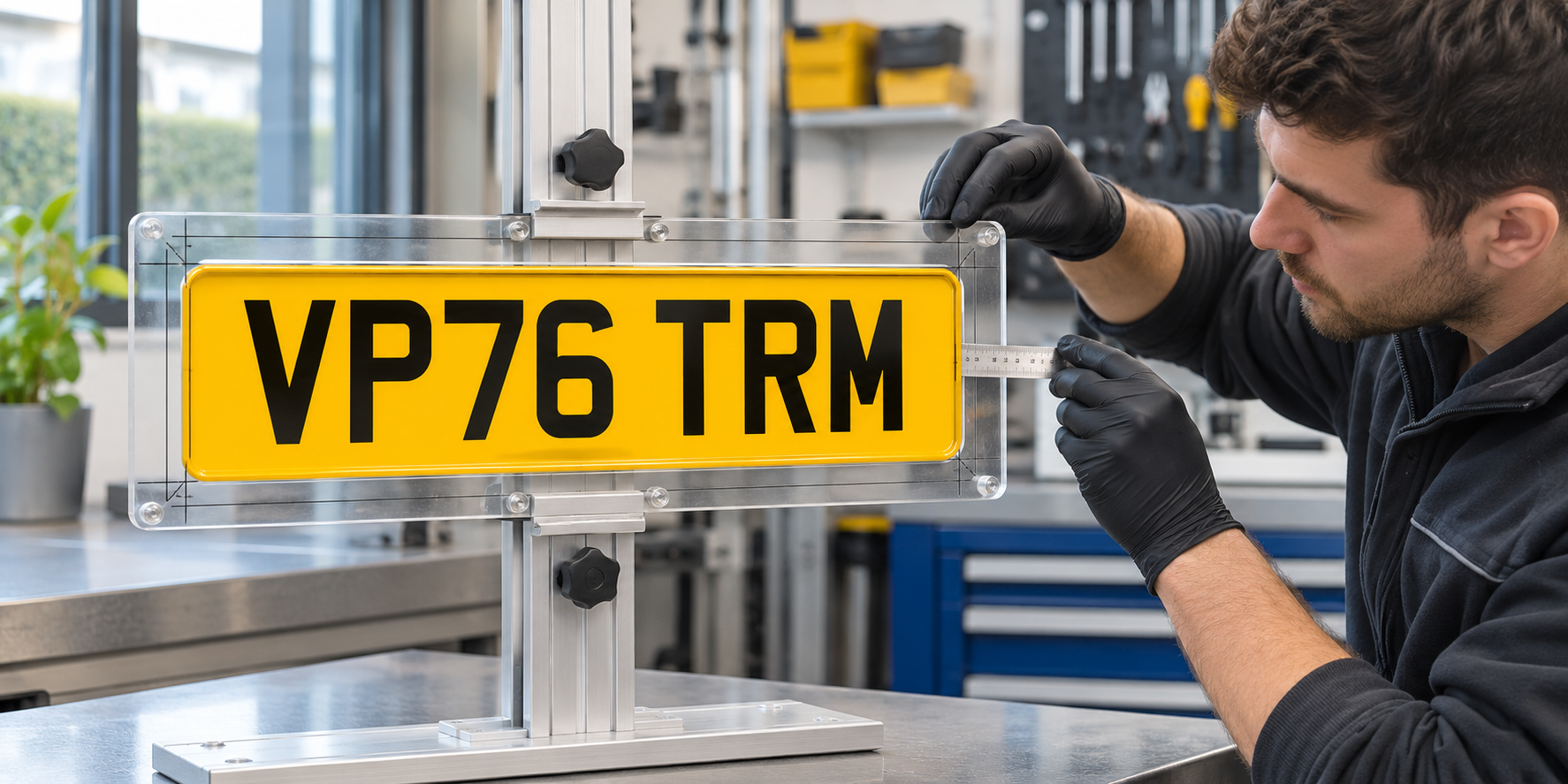
A finished number plate is a complete product
A number plate is more than a piece of acrylic around some characters. Current GOV.UK rules require modern road-use plates to use reflective material, the correct white or yellow background, supplier identification and the applicable British Standard marking.
Cutting the outer edge after manufacture can remove required markings, reduce the space around the registration or disturb the plate's layered construction. A registration that still appears to fit is not enough on its own, so do not treat a finished road-use plate as material to trim at home.
- Do not cut through supplier or standard markings.
- Keep the plate's complete construction intact.
- Check the whole specification, not only the characters.
- Order another size rather than altering a finished plate.
The blank margin is part of the layout
UK display regulations prescribe character height, stroke width, spacing and minimum margins. For the common 79mm road-use character layout, the minimum margin around the registration is 11mm. A smaller outer plate is only suitable when the registration and its complete layout still fit the applicable requirements.
Measure from the characters as well as the vehicle recess. Trimming one side to clear a camera, sensor or bumper curve can leave an uneven or insufficient margin, while trimming the lower edge can remove the supplier and British Standard information.
- Measure every outer edge separately.
- Keep the required margin around the full registration.
- Protect the lower supplier and standard markings.
- Do not alter one side just to avoid nearby trim.
A short registration may allow a shorter new plate
A registration with fewer or narrower characters can require less overall width while retaining the prescribed character size, spacing and margins. That is why a correctly manufactured short plate can differ from a standard plate that has simply been cut down.
Enter the registration before choosing a size in the Vista builder and use the available character limits as an ordering check. A short registration does not remove the road-use rules, and changing the plate size must not change the registration spacing.
- Start with the exact registration.
- Choose the size after checking character fit.
- Keep the prescribed group spacing.
- Use Road Legal for public-road use.
Smaller-character exceptions are limited
The DVSA MOT manual notes that certain tricycles, quadricycles and imported vehicles without space for standard-sized plates can use smaller plates. The display regulations contain specific conditions for those vehicles; a small recess on an ordinary car does not create a general permission to reduce characters or margins.
If the vehicle has a factory compact recess or an unusual construction, identify the vehicle category and measure the available fixing area before ordering. Ask the supplier about the correct specification rather than copying a plate that may already be unsuitable.
- Confirm the vehicle category before using an exception.
- Measure the factory recess accurately.
- Do not copy an unknown existing plate blindly.
- Ask before ordering an unusual specification.
Measure and order the replacement instead
Measure the usable width and height, noting holders, screw points, cameras, lamps, sensors and curves. Check the front and rear separately, then choose the largest suitable plate that accommodates the complete registration and required layout. Have the required identity and entitlement documents ready for a road-use order.
Dry-fit the replacement before drilling or exposing adhesive. Keep it upright, secure and fully visible, with fixings clear of every character and lower marking. The current MOT manual lists a plate that does not conform to the specified requirements as a major defect. Official guidance checked on 12 November 2026; the manual was updated on 14 October 2026.
- Measure the mounting area, not only the old plate.
- Check the front and rear separately.
- Dry-fit before making holes or bonding.
- Complete a final visibility and security check.