
Damaged number plates: an MOT and replacement guide
Check cracks, delamination, fading, fixings and legibility before an MOT, then plan a suitable replacement plate if needed.
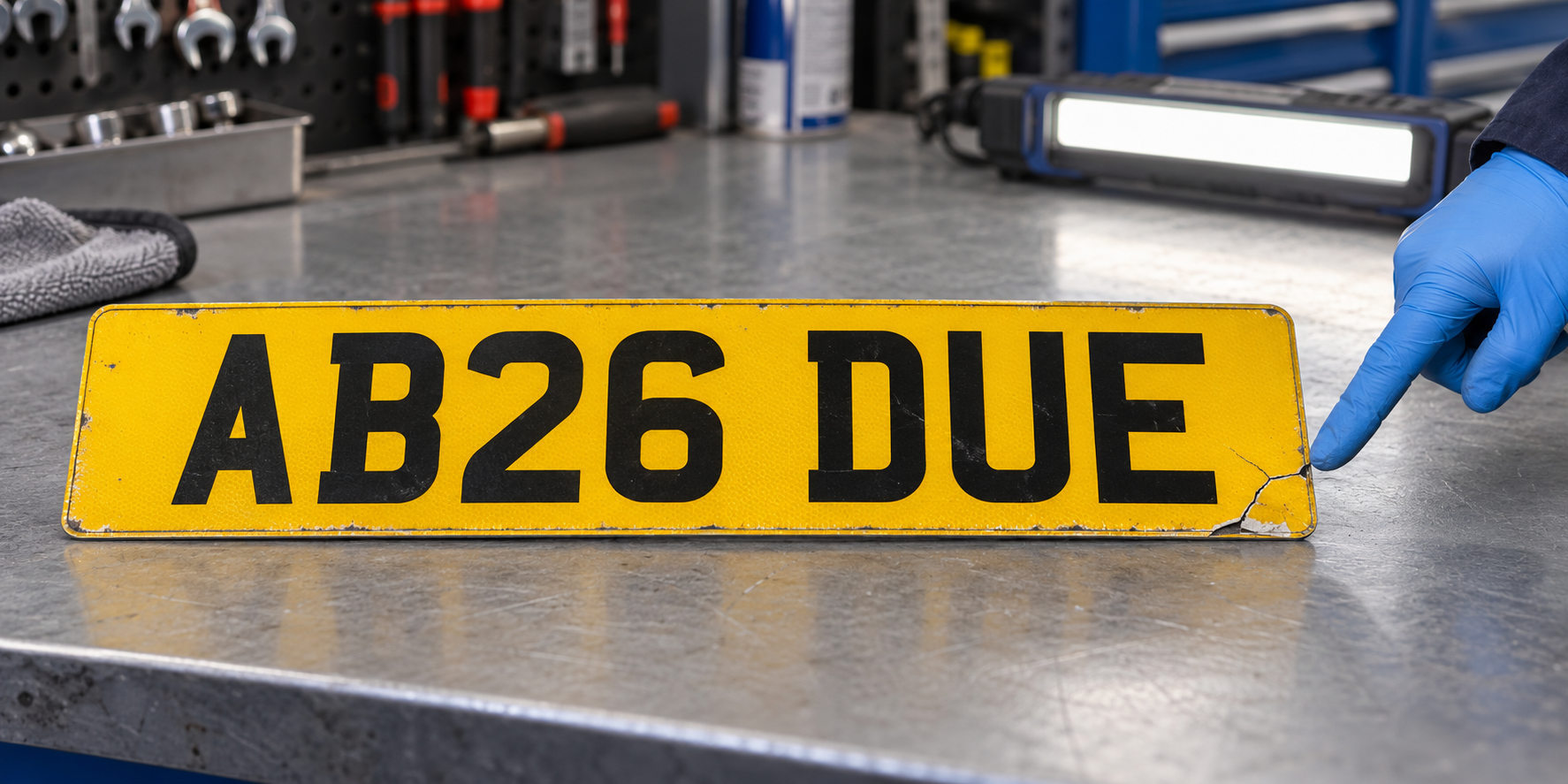
Inspect the whole plate in good light
Clean the plate gently, let it dry and look at it straight on. Check for cracks, chips, fading, lifting layers, trapped moisture and dirt that remains around raised lettering. Read every character from a few metres away and repeat the check at the front and rear.
The current DVSA MOT manual says a plate must not be obscured, excessively damaged, deteriorated or delaminated. The issue is not only appearance: damage or non-reflective material can affect how the registration is identified by people and ANPR cameras.
Check security and legibility
Hold the plate carefully and check whether it moves in its holder or at its fixing points. A missing plate, or one so insecure that it is likely to fall off, is listed as a major MOT defect. A missing or illegible inscription is also a major defect.
Look closely at screws, caps and bolts. Their position must not change the appearance or legibility of a character. Replace an unsuitable fixing rather than adding tape or another attachment over the registration.
Know what an MOT check does not prove
An MOT result is not a complete certificate that every detail of a plate meets the road-use rules. The DVSA manual says the MOT tester does not need to check the supplier name, postcode or British Standard number.
Those markings still matter for a road-use replacement. GOV.UK says a number plate must show its supplier and the applicable British Standard; for plates fitted after 1 September 2021, that standard is BS AU 145e. The plate must also have the required reflective background, colours and black characters.
Decide whether to replace one plate or a pair
If damage is limited to one end of the vehicle, you can order the correct single plate: white for the front or yellow for the rear. Compare its size and lettering finish with the undamaged plate first. A pair may be a better fit for your preference if both plates are ageing or you want matching finishes.
Measure the existing plate and mounting area before changing size. In the Vista builder, select Road Legal for public-road use, then check the registration, position, size, lettering, badge, border and fixings shown in the preview.
Prepare the documents and fit the replacement securely
GOV.UK says road-use plates can only be made up by a registered number plate supplier. The supplier needs original documents that prove your name and address and show that you are entitled to use the registration; check the official list before ordering.
Before fitting, compare every character with your entitlement document and inspect the new plate for damage. Follow the fixing instructions, keep screws clear of the characters and make sure the plate sits securely. Official guidance checked on 12 October 2026.
- Clean and dry both plates before judging their condition.
- Check cracks, fading, lifting layers and trapped moisture.
- Make sure the plate and holder are secure.
- Keep every fixing clear of the registration characters.
- Use Road Legal and prepare the required documents for a road-use replacement.