
UK number plate sizes: does every car need 520 × 111mm?
Understand what 520 × 111mm means, which character dimensions and margins matter, and how to choose a plate that fits your vehicle and registration.
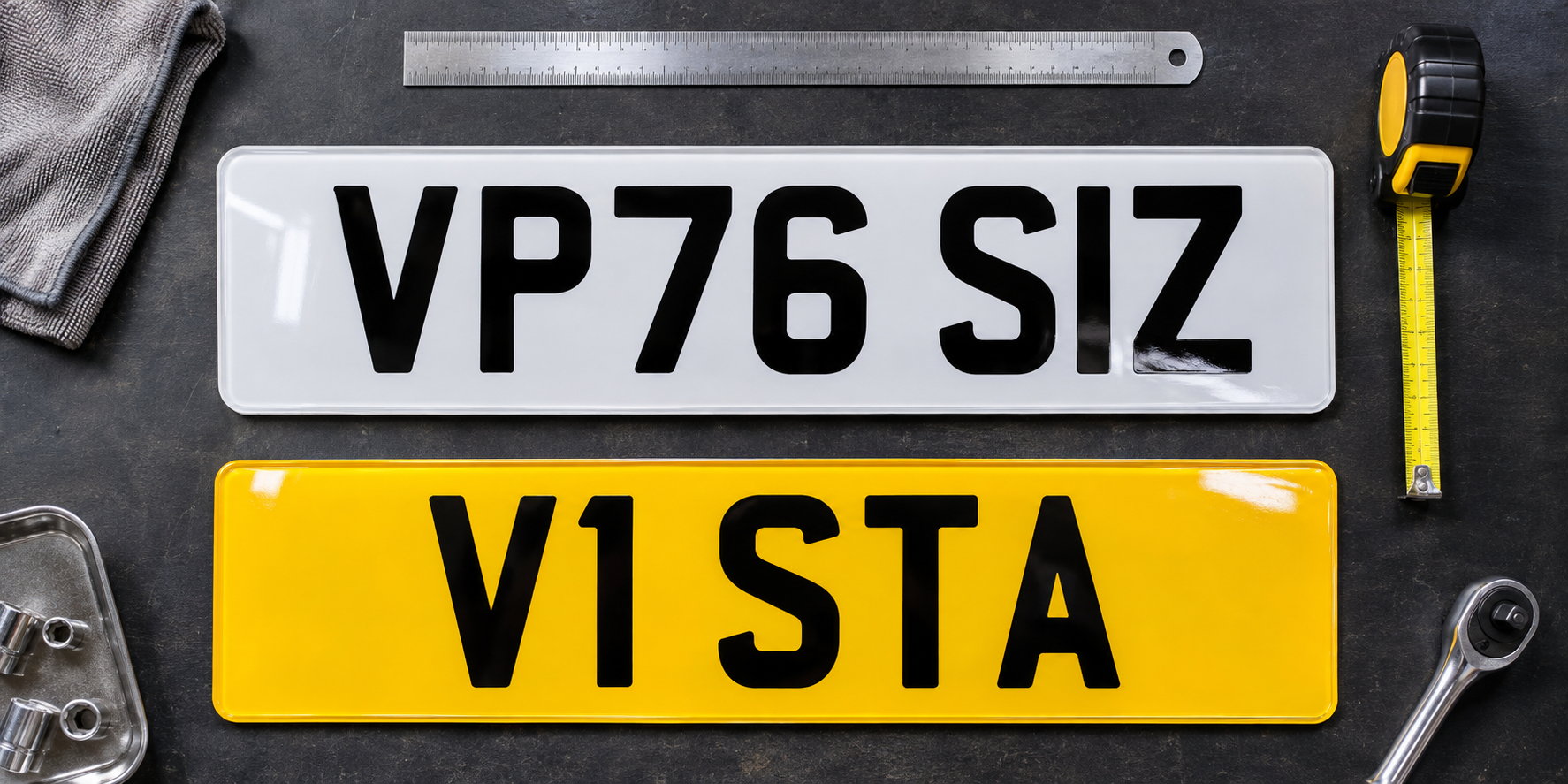
Start with the standard size, then check the vehicle
Vista's Standard Oblong car plate is 520 × 111mm. It is the usual starting point in the builder, but the vehicle in front of you still decides whether that outer size suits the mounting area.
Measure the flat usable width and height at the front and rear separately. Note any recess, plinth, holder, camera, lamp, trim, curve and existing fixing holes. Do not assume that a wide rear recess means the front bumper uses the same plate size.
- Measure the usable mounting area in millimetres.
- Check the front and rear independently.
- Record holders, plinths and existing holes.
- Keep cameras, lamps and trim clear.
The road-use rules begin with the registration layout
For a modern road-use plate, the important dimensions are not limited to the outer rectangle. DVLA leaflet INF104 gives the prescribed character height, width, stroke, spacing and minimum margins for new and replacement plates fitted from 1 September 2001.
For the usual 79mm characters, INF104 specifies 50mm character width except for 1 and I, a 14mm stroke, 11mm between characters, 33mm between the two groups and an 11mm minimum margin. Those dimensions explain why the registration length affects how narrow a compliant plate can be.
- Keep every character at the prescribed size.
- Preserve the space within and between groups.
- Allow the minimum edge margins.
- Do not shrink or squeeze a registration to fit a recess.
A shorter registration can allow a shorter plate
The regulations set minimum margins around the registration rather than declaring that every car plate must have one universal outer width. A shorter registration may therefore fit a shorter oblong plate while retaining the correct characters, group spacing and margins.
That does not make any small blank suitable for road use. A plate must still accommodate the full registration layout and required lower markings. Rearranging characters, reducing the prescribed spacing or trimming the plate close to the lettering is not a lawful way to make it fit.
- Enter the registration before choosing a short size.
- Use the builder's character limit as an ordering check.
- Keep the registration groups unchanged.
- Choose Road Legal for public-road use.
Shape and line layout matter as well as width
The current DVSA MOT manual recognises single-line and two-line plate formats, while three-line layouts are limited to older vehicles first used before 1 September 2001. Motorcycles, imported vehicles without space for a standard plate and some other vehicle classes have separate dimensional provisions, so use the relevant guidance rather than scaling down a car layout.
Vista's builder includes Standard Oblong, shorter oblong, hex, 4×4 Square and Range Rover rear choices. Select the shape only after checking the mounting area, registration length and intended use; available lettering, badges, borders and holders can change with the chosen size.
- Match the line layout to the vehicle and registration.
- Check shaped plates against the full recess.
- Read the motorcycle or imported-vehicle guidance where relevant.
- Review the available extras after selecting the size.
Complete a size and visibility check before ordering
Make a paper or card template when the fit is close. Hold it against the intended mounting position and check the full outline, viewing angle, tailgate or bonnet movement and clearance around cameras, lamps and trim. A compliant registration layout still needs a secure, visible mounting position.
In the builder, review the complete front and rear previews, then check the registration, use mode, size, lettering, extras and fixings. Current GOV.UK guidance also requires modern plates to use reflective material, black characters on the correct white or yellow background, supplier identification and the applicable British Standard marking. Official guidance checked on 5 November 2026.
- Test a full-size template before drilling.
- Read every character in the final preview.
- Check the white front and yellow rear separately.
- Keep the plate secure, upright and unobstructed.
- Ask Vista before ordering if the fit remains uncertain.